
Building Rainfall Preparedness in Qatar: Facility Safety Advisory

Every property owner in Qatar asks the same question at some point: how much should we actually be budgeting for building maintenance this year? Qatar’s extreme summer heat, high humidity, and coastal air mean buildings here work harder than in most parts of the world. Maintenance is not optional. It decides how long an asset lasts.
Going into 2026, rising utility tariffs, stricter Civil Defence compliance checks, and aging MEP infrastructure in older Doha buildings are all pushing maintenance budgets up. This guide breaks down where your money actually goes, what is changing this year, and how a smarter maintenance plan can keep costs steady instead of reactive.
A few local factors make Qatar’s maintenance costs different from other markets.
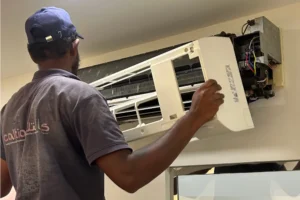
Air conditioning, whether chillers, VRF, or DX split systems, usually takes up the single largest share of a Qatar building’s maintenance spend. It is often 30 to 40 percent of the total MEP maintenance budget for commercial properties. Budget for quarterly filter and coil servicing, annual refrigerant checks, and an emergency repair reserve for peak summer months, when AC failures spike sharply and callout costs rise with demand. See our HVAC maintenance services for what a proper preventive plan should include.
Panel inspections, wiring checks, and low current system upkeep such as BMS, access control, and CCTV are a smaller but critical line item. A neglected electrical system is a leading cause of building fires in Qatar. Budget for annual thermal imaging surveys on distribution boards in addition to routine servicing. Our electrical maintenance services cover both.
Water supply, drainage, and sanitary systems need steady attention, especially in older buildings where corroded piping causes leaks that go unnoticed for weeks. Undetected leaks are one of the costliest maintenance surprises. Read our guide on spotting hidden water leaks before they cause damage, and see how preventive plumbing maintenance avoids costly business disruptions. Full plumbing coverage is outlined on our plumbing systems page.
This is a required, compliance driven cost. Sprinklers, fire pumps, suppression systems, and alarm panels need scheduled inspection, testing, and maintenance (ITM) to keep your Fire Safety Certificate valid. Budget for annual third party testing on top of routine servicing. See our firefighting systems and fire alarm systems services for scope and compliance details.
Beyond physical systems, budget for the coordination side too, including scheduling, reporting, vendor management, and helpdesk support. Many owners underestimate this cost, assuming AMC fees cover everything. Our facility management services explain what falls under FM versus standard AMC coverage.
Rather than budgeting reactively, most Qatar property owners are moving toward Annual Maintenance Contracts (AMC), which turn unpredictable repair costs into a fixed, plannable line item. Typical tiers include:
Our detailed breakdown of Annual Maintenance Contracts for HVAC, electrical, and plumbing systems walks through how each tier affects your annual budget. Our guide on 7 signs it’s time to switch maintenance contractors is worth reading before you renew an existing AMC, since you may be overpaying for coverage you no longer need, or underinsured against the risks that matter most.
The single biggest lever is shifting from reactive repairs to Planned Preventive Maintenance (PPM). Buildings on a structured PPM schedule consistently report fewer emergency callouts, lower energy use (which also helps toward Kahramaa’s conservation incentives), and longer equipment life. All of this lowers total cost of ownership over a 3 to 5 year period, even if the upfront AMC fee looks higher than ad hoc repairs.
Building maintenance costs in Qatar for 2026 will be shaped by climate demands, tighter compliance enforcement, and an aging building stock reaching major repair age. Owners who budget ahead of time, with a fixed AMC, a PPM schedule, and a reserve for compliance and peak season costs, consistently spend less over time than those who wait for something to break.
If you want a clear, no obligation breakdown of what your building should budget for in 2026, contact Caltiq for a free site visit and quote.
Building maintenance costs in Qatar vary by property size, age, and system complexity, but most commercial buildings spend the largest share of their maintenance budget on HVAC, often 30 to 40 percent of the total, followed by electrical, plumbing, and fire and life safety systems. Owners on a fixed Annual Maintenance Contract (AMC) typically see more predictable annual costs than those paying for repairs on an ad hoc basis.
AMC pricing in Qatar depends on the package tier, such as Silver, Gold, Platinum, or Titanium, and whether it is Comprehensive (labor and parts included) or Non Comprehensive (labor only, parts billed separately). Comprehensive contracts cost more upfront but remove the risk of surprise repair bills, while tiered non comprehensive plans let owners scale coverage to their building's actual risk level. See our AMC breakdown for how each tier is structured.
Qatar's air conditioning systems run almost non stop for 7 to 8 months a year due to extreme summer heat, which wears down compressors, coils, and chillers much faster than in cooler climates. This constant load makes HVAC the single largest recurring maintenance expense for most Qatar properties.
Yes. Planned Preventive Maintenance (PPM) reduces emergency callouts, lowers energy use, and extends equipment life, which lowers total cost of ownership over a 3 to 5 year period, even though the upfront AMC fee can look higher than paying for repairs only when something breaks.
Fire and life safety systems in Qatar must meet Qatar Civil Defence Technical Requirements, which require annual inspection, testing, and maintenance (ITM) along with Fire Safety Certificate renewal. Owners should budget for third party testing fees on top of routine fire alarm and firefighting system servicing.
The most commonly overlooked costs are peak summer emergency repair premiums, annual compliance and certification renewal fees, and end of life replacement of major components like chillers and pumps, which servicing alone cannot prevent. A sinking fund for capital replacement is recommended alongside routine AMC coverage.
WhatsApp us